Not Logged In
Education is not to be finished
You have been logged out. Please log in to continue.
Notifications
No notifications yet
We'll notify you when something new arrives
The Best Homeschooling Resources for STEM Subjects (And How to Actually Use Them)
Homeschooling parents rarely struggle to find STEM resources; a quick search turns up hundreds of free websites, curriculum kits, and YouTube channels. The real struggle is figuring out which ones are actually worth a family's time and how to combine them into something that feels like a coherent education rather than a pile of disconnected worksheets and videos. If you're homeschooling and trying to build a solid STEM foundation at home, here's a practical breakdown of the resource categories worth knowing, and where each one actually fits.
1. Free structured curriculum platforms
These are the backbone resources, the ones that can carry core math and science instruction on their own if needed.i) Khan Academy remains one of the most complete free options, covering math from elementary through high school along with full science courses in biology, chemistry, and physics.ii) CK-12 offers free digital textbooks and adaptive practice problems, particularly strong for middle and high school math and science.iii) Easy Peasy All-in-One Homeschool provides a complete, free, grade-by-grade curriculum, useful for families who want a full daily structure rather than building one from scratch.These platforms are excellent for consistency, but on their own they tend to be screen-based and self-paced which works well for some kids and not others. That's usually where the next category comes in.
2. Hands-on experimentation resources
Kids retain STEM concepts far better when they're building or testing something, not just watching a video about it.- Supercharged Science offers hundreds of guided experiments alongside its curriculum, built specifically around learning by doing.- Simple household-materials science channels (like those built around everyday experiments) work well as a low-cost supplement, especially for younger kids who need a hands-on hook to stay engaged.
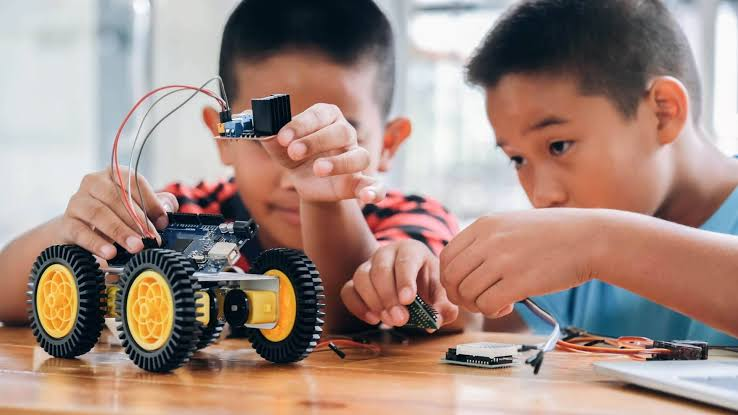
3. Coding and computer science platforms
Coding is one of the easiest STEM subjects to homeschool well, because so much of the best material is free and genuinely well-designed for kids.i) Code.org offers free, structured coding lessons organized by grade level, and is a strong starting point for families unsure whether their child will enjoy programming.ii) Scratch (from MIT) is the standard entry point for block-based coding, letting kids build simple games and animations without needing to type a line of code.iii) Free platforms like these are genuinely good for exploration, but most are self-paced and unsupervised which means a child who gets stuck on a bug or a confusing concept often has nowhere to turn except trial and error.

4. Live instruction and community
This is the gap that trips up a lot of homeschooling families. Free platforms are great for content, but they don't replace a real instructor who can answer a child's question in the moment, or the social element of learning alongside other kids, something homeschoolers have to be intentional about building in, since it doesn't happen automatically the way it would in a classroom.This is exactly the layer The STEM Educators is built to provide. Our live, instructor-led courses in coding, robotics, game development, and applied AI give homeschooling families the structured, hands-on, socially-engaged piece that free platforms alone can't offer real feedback, real projects, and a small cohort of other kids to build alongside. Many of our homeschool families use TSE courses as the "anchor" for their STEM curriculum, then supplement with free resources like Khan Academy or Scratch for independent practice between sessions.
Putting it together
A strong homeschool STEM setup usually blends all four categories: a structured platform for core concepts, hands-on experimentation to make ideas stick, free coding tools for independent exploration, and live instruction to provide real feedback and community. You don't need to use everything at once, start with one live, project-based course to anchor the week, and layer in free resources as your child's interests become clearer. To figure out your child's interests feel free to check out our STEM EXPLORER SESSION
0 Comments
You must be logged in to share a comment. Click here to Login
No comments yet. Be the first to start the conversation!