Not Logged In
Education is not to be finished
You have been logged out. Please log in to continue.
Notifications
No notifications yet
We'll notify you when something new arrives
Inside a Makerspace — what actually happens there, the pedagogy, the messiness, the magic!
For the longest time I thought makerspace is something so big with fancy stuff but the deeper you understand the word and the context of where it comes from you start to realize it starts with something so simple and anyone can work in it even from the comfort of their homes. So why be extra technical huh?
As maydda also knows as miss makers explains it really well that in her experience too kids working on a robot that needs to survive underwater that takes a lot of tinkering experimentation and failure, they destroyed multiple raspberry pi boards which costs around 28k each and the point was not to worry about the failure but to keep tinkering and making and keep going that's how a kids work in a makerspace. That is a makerspace.
Tools used in the makerspace
A makerspace usually have the basic tools to make things, 3D Printing & Digital Fabrication, Electronics & Robotics, Woodworking & Hardware, Fiber Arts & Crafts from scissors to a 3d printer
Why Mess Is the Point
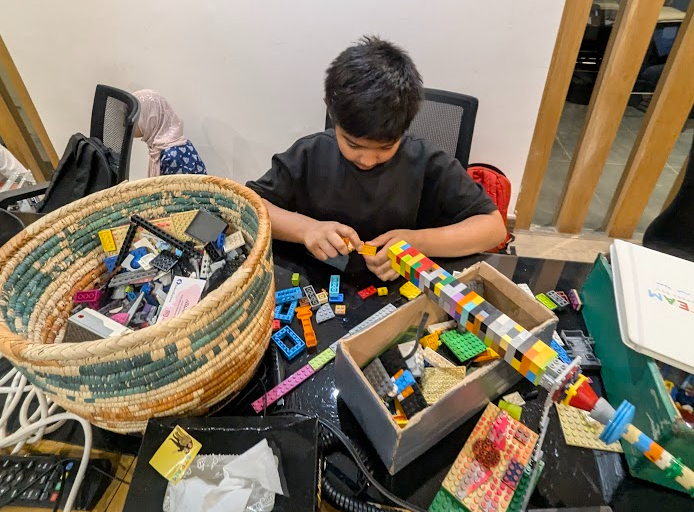
Many parents walk into a makerspace and immediately notice the mess. There are wires on the floor, cardboard scraps everywhere, half-finished prototypes sitting on tables, and students constantly moving things around. It can look chaotic. But that chaos is often where the learning happens. In traditional classrooms, students are usually rewarded for getting the right answer. In a makerspace, students are rewarded for trying different approaches. A failed prototype is not considered a bad outcome. It is evidence that learning took place. When a child spends two hours building something that eventually falls apart, they have still learned about design, structure, problem-solving, and persistence. The mess is not a side effect of learning. The mess is learning.
Why STEM Was Never Meant to Be Four Separate Subjects
One of the biggest misconceptions about STEM is that Science, Technology, Engineering, and Mathematics are separate disciplines. Real-world problems do not work that way. Suppose a student wants to build a weather station. They need science to understand weather patterns. They need mathematics to analyze the data. They need technology to collect and process information. They need engineering to design and build the system. Everything becomes interconnected. This is why makerspaces are so powerful. Instead of teaching STEM subjects separately, they allow students to experience how these disciplines naturally work together to solve problems. Students stop asking, "When will I ever use this?" Because they are already using it.
You Do Not Need a Lab — The Home Makerspace
One of the biggest myths about maker education is that you need access to a professional workshop. You don't, a makerspace can exist in a corner of your living room. It can be a drawer filled with cardboard, tape, markers, old electronics, batteries, and random materials waiting to be transformed into something new. Some of the best maker projects begin with ordinary household items. A cardboard bridge becomes a lesson in structural engineering. A homemade catapult becomes a lesson in physics. A broken toy becomes an opportunity to understand how mechanisms work. The goal is not to build perfect projects. The goal is to build curious learners. Because at its core, a makerspace is not a room. It is a mindset. A place where questions are encouraged, mistakes are expected, and making something is valued more than getting everything right on the first try and that is exactly the kind of environment where innovation begins.
0 Comments
You must be logged in to share a comment. Click here to Login
No comments yet. Be the first to start the conversation!