Not Logged In
Education is not to be finished
You have been logged out. Please log in to continue.
Notifications
No notifications yet
We'll notify you when something new arrives
How Parents Can Help Kids Use Devices More Productively
It's a scene almost every parent knows by heart. You walk into the room and your child is hunched over a tablet, thumb moving on autopilot, scrolling through video after video. You ask them what they're watching. They shrug. You ask them what they learned. Another shrug. An hour has gone by and somehow nothing has actually happened. The instinct most parents have at this point is to set a timer: thirty minutes of screen time, then off. And while limits matter, they miss the real question parents should be asking. It's not how long my child is on a device; it's what they are actually doing with it. A child who spends 45 minutes building a game in Scratch is having a very different experience than a child who spends 45 minutes scrolling reels. Same screen, same hour, completely different outcome. So instead of just fighting the clock, here's how parents can help kids turn screen time into something that actually builds a skill.
1. "Consuming" and "Creating"
Not all screen time is equal, and treating it that way is where most screen time rules fall apart. Try sorting your child's device use into two buckets: Consuming (watching videos, scrolling feeds, passively playing games) and Creating (coding a project, editing a video, designing something, building in Minecraft with a purpose). The goal isn't to eliminate consuming entirely; it's to balance both. A simple house rule like "an hour of building for every hour of watching" reframes the device from a babysitter into a tool. This idea closely aligns with a concept from Atomic Habits called temptation bundling—pairing something you enjoy with something that requires effort. When children know that their favorite activity is tied to a productive one, their brains begin associating the two. Over time, creating no longer feels like a chore but becomes part of the reward itself. Instead of fighting screen time, you're teaching them to use it intentionally and helping productive habits stick naturally.
2. Parents ❌ Friends ✅
There is no friendship, no love, like that of the parent for the child.
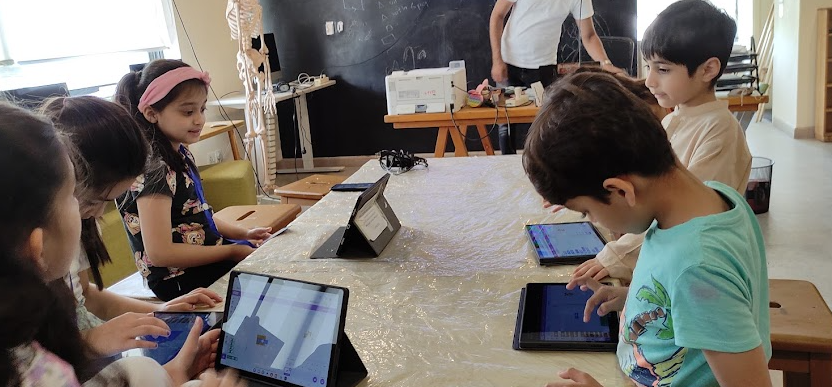
Parental control apps have their place, but they don't teach judgment; they just delay the moment a child has to develop it themselves. Sitting with your child while they use a device, doing whatever activity they are doing along with them, even for ten minutes, and asking, "What are you making?" or "How does this work?" does more for long term habits than any app blocker. It also gives you a natural window to introduce more productive alternatives when you notice they're stuck in a passive loop.
3. Device Free Hours
Kids don't need devices banned; they need clear windows where devices simply aren't part of the picture. Mealtimes, the hour before bed, or the first thirty minutes after school are good places to start. These windows aren't punishment; they their brains a chance to reset from constant stimulation, which in turn makes the time they do spend on a device more intentional rather than compulsive.

4. Lead by Example
Kids don't learn productive device habits from rules; they learn them from what they watch adults do. A parent who reaches for their phone the moment there's a lull is teaching a very different lesson than a parent who reaches for a book, a sketchpad, or sits down to actually build something alongside their child. You don't have to be a tech expert to model this; you just have to show them that devices are tools you use, not habits that use you.
5. Productive Consuming
Parents can't just magically tell their kids, "Hey, don't spend too much time on your phones." More often than not, kids won't listen; they'll simply grow irritated and resentful. While the amount of time spent on a phone matters, what matters even more is how that time is being spent. If your kids are addicted to watching brain rot content, a better solution is to get them hooked on STEM channels that create engaging, educational, and inspiring videos. These can spark curiosity and encourage children to explore STEM. You might be wondering, "Where can I find such channels?" Don't worry—we've got you covered!
AstroKobi is perfect for kids who are fascinated by space and constantly ask questions about the universe. His videos make complex astronomy topics easy to understand and can spark a lifelong interest in astrophysics and space exploration.
If your child loves technology, inventions, and asking "How does this work?", Cleo's channel is a great fit. She turns cutting-edge science and innovation into exciting and inspiring stories.
Ideal for younger children who learn best through colorful animations and storytelling. The channel makes science, health, and everyday concepts fun, engaging, and easy to understand.
0 Comments
You must be logged in to share a comment. Click here to Login
No comments yet. Be the first to start the conversation!