Not Logged In
Education is not to be finished
You have been logged out. Please log in to continue.
Notifications
No notifications yet
We'll notify you when something new arrives
Built Different
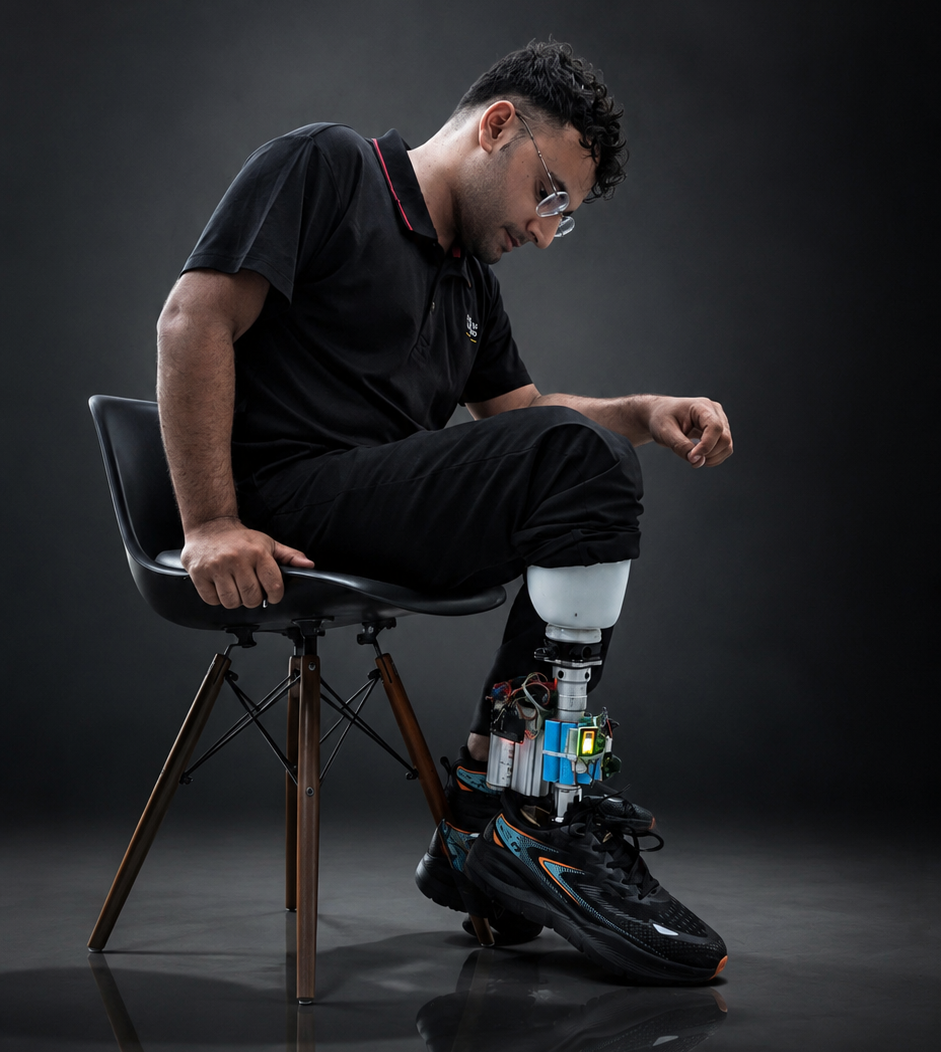
Take a moment and look at the leg in this photograph. There is no skin-colored cover on it. Nothing is trying to look like a real leg. You can see the socket, the metal frame, the wires, and a small light glowing near the ankle. This is the leg I built. It is also the leg I walk on every day .For most people, a prosthetic limb is a reminder of something lost. For me, being both the person who engineered it and the person who depends on it, it has become something different. It has become a question: when someone lives with a disability, where does that disability actually live?
"A person can never be broken"
In 1982, a seventeen-year-old climber named Hugh Her was caught in a blizzard on Mount Washington in the United States. He survived, but frostbite took both of his legs below the knee. Doctors told him he would never climb again. He did climb again. He also went on to become a professor at MIT and one of the most important names in bionics in the world. In his 2014 TED talk, he said something that changed how many of us think about this subject: "A person can never be broken." The meaning is simple and powerful. The human being is not the part that failed. The tools around us, and the world we have built, are what fail people. And tools can be redesigned. I believe that is true. But I also know this idea is easy to admire from a distance and much harder to live every day. So I want to take it a little further.
Disability is a mismatch, not a verdict
Think about a staircase. For someone in a wheelchair, a staircase is a wall. Put a ramp next to it, and the wall disappears. The person did not change. Only the design did. This way of thinking is known as the social model of disability. It says a difference in the body is one thing, and disability is what happens when the world is not built for that difference. You could even say that all of us rely on technology to get through the day. We use lifts, cars, glasses, and phones. In a way, every human being is extended by tools. But there is one big difference. When a lift stops working, you take the stairs. When a prosthetic leg stops working, the person using it may not be able to leave home at all. The question is not whether we depend on technology. The question is how much of your life stops when that technology lets you down. That is why this idea matters so much. If disability lives in the technology, then weak technology is not a small problem. It is the disability. And that makes it something engineers can, and should, work to solve.
A leg does more than walk
Most people think of a leg as something that moves you from one place to another. If that were its only job, a simple artificial leg would be enough. But a real leg does much more. It feels the ground beneath you. It knows where your foot is without you looking. It softens every step, adjusts on slopes, catches you when you stumble, responds to what you want to do almost before you decide to do it. A basic prosthesis gives you the shape and the support of a leg. It cannot give you all of that feeling and response. Closing that gap is the real work of bionics, and it is the work I chose to take on.
Building instead of waiting
Advanced bionic legs do exist. But for most people on this planet, they might as well not. The World Health Organization estimates that only one in ten people who need assistive devices, including prosthetic limbs, can actually get them. The reasons are cost, availability, a shortage of trained specialists, and a lack of funding. In Pakistan, as in much of the developing world, a commercial bionic leg costs far more than most families could ever afford. So I decided not to wait. I built my own. My goal was never to copy the most expensive devices on the market. It was to prove that a leg which understands what its user is trying to do does not have to cost a fortune. A bionic leg that almost nobody can buy does not solve disability for almost anybody. The system I developed is now in the process of patent protection, which is why I am not sharing its technical details here. What I can share is what it has already achieved. My research on it has been published in a peer-reviewed journal [5], and the project has been recognized with national media coverage and innovation awards in Pakistan. None of this means the problem is solved. It means the problem is a little smaller than it was.
Where the field is heading
Some of the most exciting progress in recent years has come from researchers at MIT. In a normal amputation, the muscles in the remaining limb are cut and left disconnected. The MIT team developed a new kind of surgery that reconnects those muscles in pairs, so they keep working together the way they naturally did. This allows the brain to sense where the artificial leg, and allows the leg to follow the person's own nervous system. In a 2024 study published in Nature Medicine, seven people who had this surgery walked on a bionic leg controlled by their own nerves. Compared with people who had a traditional amputation, their fastest walking speed was 41 percent higher. They also handled slopes, stairs, and obstacles far more naturally. That is where bionics is going: towards a limb that is not just attached to a person, but truly connected to them.
The honest part
It would be easy to write only about breakthroughs. But anyone living with limb loss deserves the full picture. Many people stop using their prosthetic limbs. A major review of 25 years of research found that around a quarter of adults with upper-limb prostheses eventually stopped using them. The reasons are practical: discomfort, weight, poor function, and devices that simply do not suit the way people actually live. Powered limbs bring their own challenges too. They need charging. They need maintenance. They have to keep working reliably in real life, through heat, sweat, long days, and rough ground, and that is harder than it sounds. Even the most advanced devices in the world still cannot give back the full sense of touch. And the cost still keeps them out of reach for most of the people who need them. I do not see these as reasons to lose hope. I see them as a to-do list
Will people ever choose a bionic limb?
A generation ago, this question would have sounded like science fiction. Today it is a real one. For a healthy leg, the answer right now is no. Nature still wins. A biological limb feels, heals itself, lasts a lifetime, and runs on food rather than batteries .But for someone living with a limb that is painful, badly damaged, or no longer works, the answer is already becoming less simple. And every advance makes it a little less simple still. The most honest way to describe the future is this: the gap between bionic and biological is closing. In some specific tasks, machines can already give what a weakened body cannot. Whether that gap ever closes completely is still unknown. What is certain is that it keeps getting smaller ,and every step forward moves disability out of the person and into the category of problems we know how to solve.
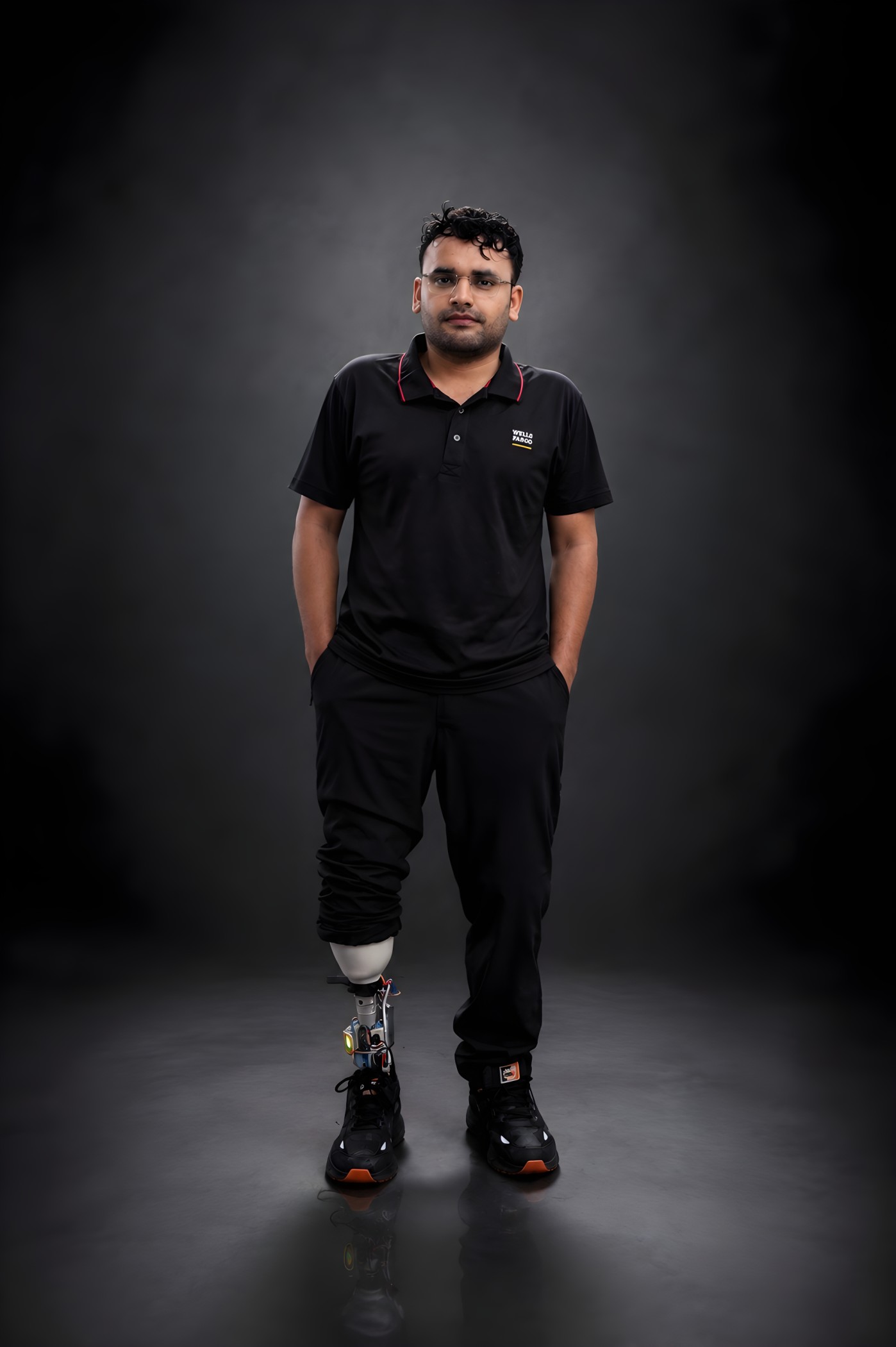
Back to the photograph
When I look at the leg in these photographs, I do not see a body that failed. I see technology thatkeeps getting better, thanks to researchers and engineers around the world, and to people whodecided that waiting for the right device was not the only option.
A person can never be broken.Our job is to make sure our technology is not broken either.
- Herr, H. (2014). The new bionics that let us run, climb and dance. TED Talk.
- Song, H., et al. (2024). Continuous neural control of a bionic limb restores biomimetic gait after amputation. Nature Medicine.
- World Health Organization. (2017). WHO Standards for Prosthetics and Orthotics. Geneva: WHO
- Biddiss, E. A., & Chau, T. T. (2007). Upper limb prosthesis use and abandonment: A survey of the last 25 years. Prosthetics and Orthotics International, 31(3).
- Ghafoor, A., Awan, M. I., & Hassan, S. S. (2026). A Low-Cost Flex Sensor Gait Phase Gating Method for Powered Ankle Prostheses. International Journal of Innovations in Science and Technology, 8(3), 1366 to 1378.
0 Comments
You must be logged in to share a comment. Click here to Login
No comments yet. Be the first to start the conversation!