Not Logged In
Education is not to be finished
You have been logged out. Please log in to continue.
Notifications
No notifications yet
We'll notify you when something new arrives
AI Literacy for Kids: What Should Your Child Actually Understand About AI?
Most kids today already talk to AI more than they realize, by asking a voice assistant a question, getting a video recommendation, or watching a chatbot finish their sentence. What they usually don't have is any real understanding of how any of it works. That gap is exactly what "AI literacy" is meant to close and it's quickly becoming as fundamental to STEM education as learning to code was a decade ago.
AI literacy isn't the same as "using AI"
There's an important difference between a child who knows how to type a prompt into a chatbot and a child who understands, even at a basic level, what's actually happening behind that response. AI literacy means a child can answer simple but important questions: Where did this answer come from? Could it be wrong? Why did the AI suggest this video and not another one? A child who can ask these questions is building judgment, not just a habit and that judgment is what actually protects them as AI tools get more common in classrooms, apps, and daily life.
Why this matters at a young age
It's tempting to think AI concepts are too advanced for kids under 15, but the core ideas behind AI patterns, predictions, training data, and mistakes are things children already intuitively grasp in other contexts. A child who's noticed that their video app "knows" what they like has already brushed up against the idea of a trained model. The job of AI education isn't to introduce an entirely foreign concept; it's to give a name and a framework to something kids are already experiencing every day.
What kids should actually learn first
Rather than jumping into complex machine learning theory, a strong first introduction to AI for kids usually covers a few practical ideas:AI learns from examples, not instructions. Unlike a normal computer program that follows fixed rules, an AI model is trained on data and learns patterns from it which also means it can learn the wrong patterns if the data is biased or incomplete. AI can be confidently wrong. One of the most important lessons for a young learner is that AI-generated answers can sound completely certain and still be inaccurate, which is why checking and questioning AI output is a skill in itself. AI is built by people, with real choices behind it. Every AI tool reflects decisions someone made about what data to use, what to prioritize, and what mistakes to accept. Understanding this turns AI from an untouchable authority into something kids can imagine designing themselves.
From understanding to building
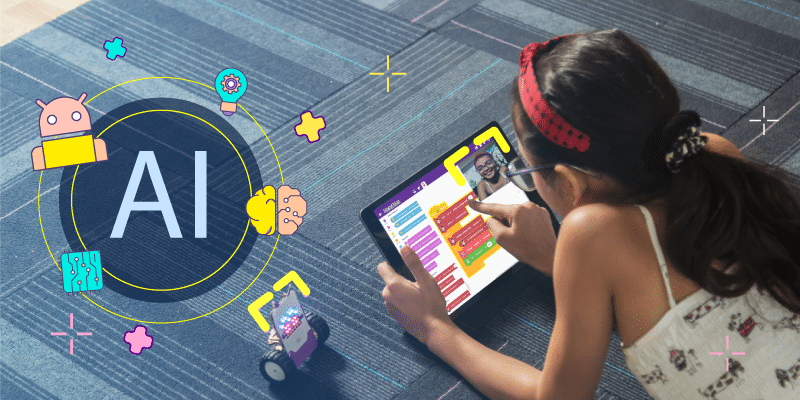
The most effective way to teach AI literacy isn't through lectures on theory, it's through small, hands-on projects where kids train a simple model themselves and watch it get things right, and occasionally wrong. Building even a basic image classifier or a simple prediction tool does more to demystify AI in an afternoon than months of reading about it, because the child sees firsthand how the "smart" behavior is really just patterns learned from examples.
0 Comments
You must be logged in to share a comment. Click here to Login
No comments yet. Be the first to start the conversation!